There is a part of my background that does not fit neatly into a traditional marketing résumé.
Before I worked in healthcare marketing, built websites, developed SEO strategies, created automation systems, or advised organizations on digital growth, I sold drugs on the dark web. I am a former dark web drug dealer.
I do not say that because I think it sounds edgy, and I do not glorify that chapter of my life. I also do not recommend the decisions that brought me there. But pretending it never happened would mean ignoring part of what shaped the way I understand technology, addiction, anonymity, trust, reputation, digital behavior, and the internet itself.
Today, I use those lessons for something completely different.
I Learned About Digital Behavior Before I Became a Marketer
Most digital marketers learn the internet through platforms such as Google Ads, Analytics, Search Console, Facebook, WordPress, CRMs, SEO tools, and marketing funnels.
My experience was different. I spent time in online environments where traditional identity, authority, and trust signals were either limited or nonexistent. In anonymous communities and marketplaces, people still had to determine who they could trust, but they had to do it differently.
Reputation mattered. Consistency mattered. History mattered. Specificity mattered. Community validation mattered. A person’s behavior over time could matter more than who they claimed to be.
That taught me something I would later recognize as central to marketing: the internet is ultimately a study of human behavior. Platforms, algorithms, and technology change constantly, but human motivations change much more slowly. People want reassurance, proof, and a sense that the person or organization in front of them understands their problem. They evaluate risk and develop shortcuts for deciding what deserves their trust.
Those same principles apply when someone is choosing an addiction treatment center, healthcare provider, agency, software platform, or almost anything else online.
The Internet Is Much Bigger Than Google
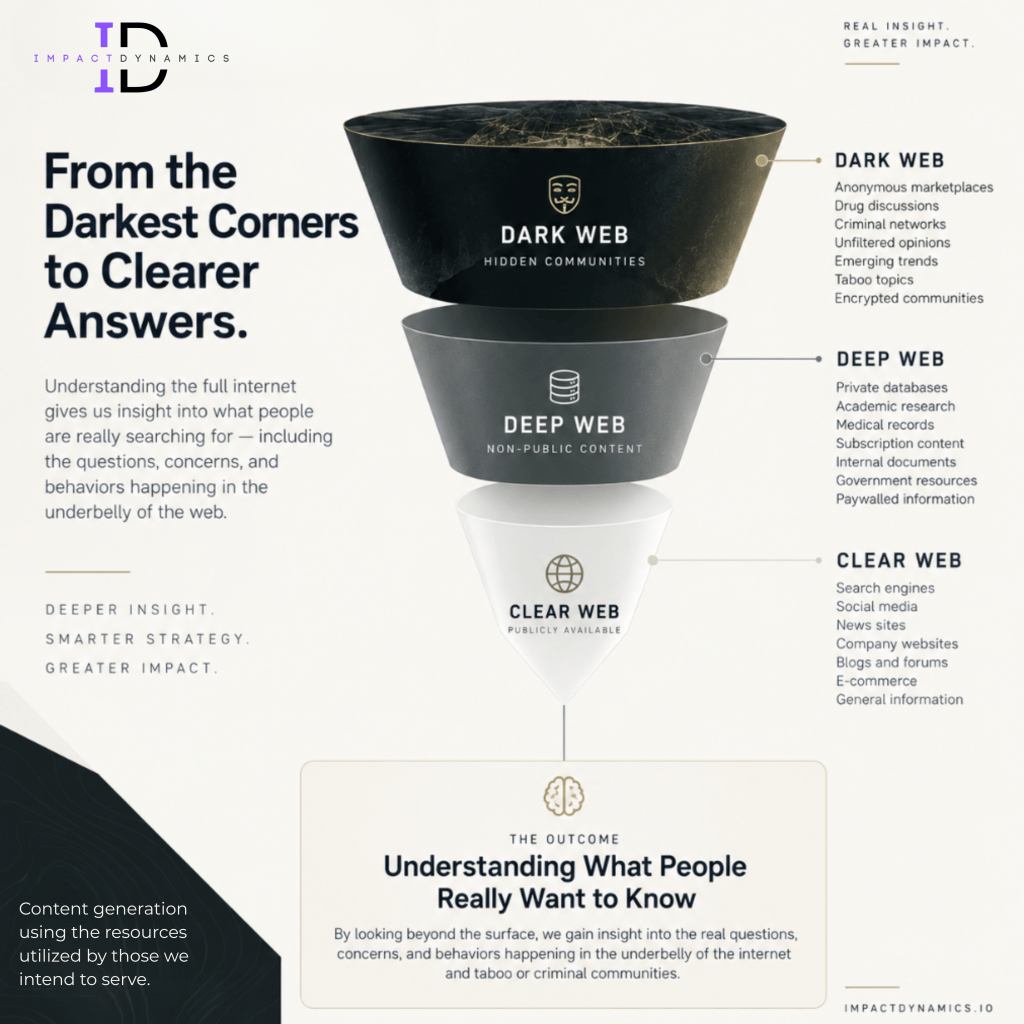
A lot of marketing strategy starts and ends with visible platforms such as Google, social media, YouTube, Reddit, and industry publications. Those platforms matter, but they are not the entire internet.
Ideas frequently develop in smaller or more obscure communities before they ever become mainstream. A new substance may circulate before treatment centers know its name. A slang term may appear in niche communities before keyword tools register meaningful search volume. A scam may spread privately before it becomes a news story, and a new technology may be discussed in specialized communities long before businesses start building strategies around it.
Information does not necessarily originate on Google. Google often reflects behavior that already exists.
That distinction matters because if your entire understanding of a market begins with what already has measurable search volume, you are often studying behavior after it has already become visible. I have always been more interested in what happens before that point and how early signals turn into broader patterns.
Why This Perspective Matters in Addiction Treatment
That background has become particularly relevant because so much of my professional career has been spent in addiction treatment and behavioral healthcare.
Drug markets change quickly. New compounds appear, old substances are reformulated, synthetic versions emerge, products receive new names, and slang evolves. Counterfeit pills may be sold as legitimate medications, while people discover new ways to concentrate, modify, or market substances long before the general public understands what they are.
By the time a subject becomes a major news story, there may already be substantial real-world behavior behind it. We have seen that dynamic around fentanyl, counterfeit pills, designer benzodiazepines, synthetic cannabinoids, concentrated kratom products, 7-hydroxymitragynine products, and other emerging substances.
From a marketing standpoint, that creates an interesting problem. Keyword research can tell you what people are searching for, but it does not always tell you what they are about to start searching for. Those are two very different things.
Understanding how communities talk about substances, what language they use, what products they are encountering, and what questions they are asking can help healthcare organizations recognize important subjects earlier. That can inform patient education, content strategy, SEO, admissions training, and conversations with families who may be encountering terminology the treatment industry has barely started discussing.
Trust Without Identity Taught Me a Lot About Marketing
One of the most interesting things about anonymous online environments is that trust does not disappear. Instead, the signals people use to establish trust change.
If you cannot rely heavily on someone’s identity, you start evaluating other things. You look at how long they have been around, whether their behavior is consistent, whether other people validate what they are saying, whether they demonstrate real knowledge, and whether their history supports their claims.
That sounds surprisingly similar to what good digital marketing looks like today.
A healthcare provider can put almost anything on its website. Phrases like “we care about our patients,” “individualized treatment,” “compassionate care,” and “start your journey today” appear across thousands of healthcare websites. The problem is that practically everyone says those things, so the phrases themselves do very little to establish trust.
Patients and families need more than claims. They need evidence. They want to know who the clinicians are, what the organization actually provides, who wrote the medical content, whether the organization’s claims can be independently verified, whether reviews support what the website says, and whether the company demonstrates genuine expertise.
That is real trust signaling, and it is something I understood conceptually long before I ever heard someone use the phrase in an SEO meeting.
Reputation Can Become Identity Online
Another lesson from anonymous marketplaces was how incredibly powerful reputation can become. In certain environments, reputation is effectively your identity because people may not know exactly who you are, but they know what your history says about you.
That concept has stayed with me throughout my career.
A company’s digital reputation today exists far beyond its own website. It exists in Google reviews, Reddit discussions, news coverage, LinkedIn profiles, professional directories, licensing databases, employee reviews, social media conversations, and increasingly in the information AI systems retrieve and synthesize about that organization.
That is why I do not think of SEO as simply placing keywords on webpages. The larger question is what the internet understands an organization to be. Who is associated with it? What expertise does it demonstrate? What do independent sources say? Are its claims consistent across the web, and does the available evidence support the way the organization describes itself?
That broader understanding of digital reputation has always made intuitive sense to me.
The Difference Between Monitoring and Participating
Talking about this background can easily create the wrong impression, so there is an important distinction. Using knowledge of underground or anonymous online environments does not mean engaging in illegal activity, buying illicit products, operating anonymous marketplaces, or interacting with criminal organizations on behalf of a client.
There is a difference between understanding an ecosystem and participating in it.
Today, the value is primarily in perspective. It means understanding that important signals may develop outside traditional marketing channels, recognizing unusual terminology, understanding how people behave differently under anonymity, and appreciating the importance of privacy, reputation, skepticism, and verification online.
It also means knowing that the visible web rarely tells the entire story.
From Exploiting Systems to Building Them
There is another reason I choose not to hide this part of my history. The trajectory matters.
At one point in my life, I used technology in ways that contributed to addiction and harm. Today, much of my work involves helping addiction treatment and behavioral health organizations reach people who are looking for help.
That contrast is not lost on me.
Recovery did not erase everything I learned. It changed what I decided to do with it. The curiosity stayed, as did the fascination with systems, the desire to understand how technology works, and the tendency to investigate things other people overlook. What changed was the purpose.
Instead of using those skills to navigate destructive systems, I began using them to build legitimate ones, including websites, search strategies, automation, admissions systems, healthcare marketing infrastructure, AI workflows, operational tools, and digital strategies designed to connect people with services that can actually help them.
Recovery Gave My Experience a Different Purpose
I sometimes think people misunderstand what recovery does to someone’s past. Recovery does not rewrite your history. It gives you the opportunity to decide what that history means going forward.
There are experiences from my past that I would never choose again, and there are consequences I would never minimize. But there were also things I learned during difficult periods of my life that became unexpectedly useful later.
Technology was one of them. Human behavior was another. Addiction was another, along with the psychology of trust. Those subjects ultimately became central to my professional life.
I did not plan that path, but looking backward, the connection is obvious.
Why I Talk About This Publicly
There is definitely a cleaner version of my professional story where I leave all of this out. It would probably be easier, and “former dark web drug dealer” is not exactly a standard LinkedIn credential.
But I have never wanted ImpactDynamics to become another agency built around polished bios, vague buzzwords, and carefully manufactured expertise.
My background is unconventional because my life has been unconventional. I have experienced addiction from the inside, recovery from the inside, and parts of the internet most marketers have only read about. I then spent years working inside addiction treatment and behavioral healthcare, where those experiences began intersecting in ways I never expected.
None of that automatically makes me good at marketing. Results still matter. Strategies still need to work. Technical recommendations still need to be correct, and organizations still need measurable outcomes.
But experience changes the questions you think to ask. It changes what catches your attention, what you recognize early, and the angles you consider when looking at a problem.
Sometimes that matters more than having the same background as everyone else in the room.
Experience Redeployed
I do not believe people should be permanently defined by the worst period of their lives, but I also do not believe we need to pretend those periods taught us nothing.
For me, this part of my past became useful when I learned how to redirect it. I took an understanding of technology, anonymous communities, trust, addiction, reputation, information networks, and online behavior and eventually applied it to something constructive.
Today, my work sits at an unusual intersection of healthcare, marketing, SEO, AI, automation, recovery, technology, and firsthand experience with parts of the internet far outside the traditional web.
It is not the background I would recommend for becoming a digital marketer, but it is mine. And it is one of the reasons I rarely look at the internet, or the people using it, only at the surface.
